Secure Digital Inheritance Platform

Legacy Vault

A secure vault for preserving sensitive records and releasing them to a trusted successor only after verification and admin approval.

Full-stack Digital Inheritance PlatformCompleted
Legacy Vault project thumbnail
Live

Overview

What the project is

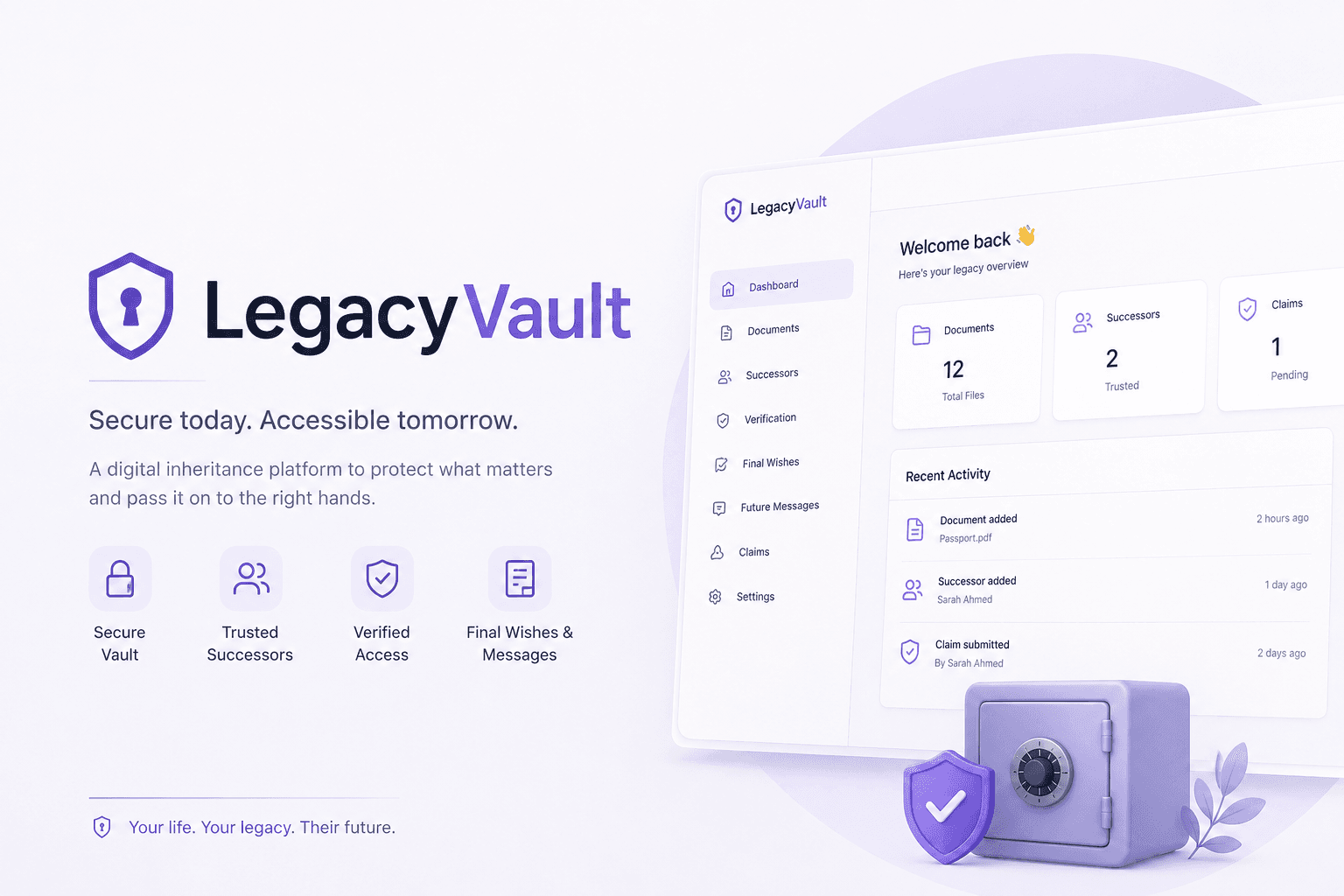
LegacyVault is a digital inheritance platform that helps users organize documents, final wishes, future messages, verification questions, and successor instructions in one protected system. A successor can request access through a structured claim flow, but vault information is released only after answer scoring and admin review.

Problem / Purpose

Why it was built

The project addresses a sensitive real-world problem: important personal, legal, financial, and digital records are often scattered or inaccessible when their owner becomes unavailable. LegacyVault creates a controlled path for preserving that information and transferring access without exposing private data prematurely.

My Role / Contribution

What I worked on

This was a collaborative project. I built the complete frontend experience and owned the core document-claiming workflow end to end, implementing both its frontend interactions and backend behavior.

  • Designed and implemented the full React frontend across public, owner, successor, and admin experiences.
  • Built the complete document-claiming workflow from successor submission through verification, review, and released vault access.
  • Implemented the frontend and backend portions of the core claim workflow, including state handling and API integration.
  • Connected protected dashboards, document management, successor setup, verification questions, and admin review surfaces.
  • Integrated Firebase authentication and backend-controlled document interactions into the user experience.

Key Features

Important product capabilities

Vault Owner Features

  • Protected dashboard for documents, successors, verification questions, final wishes, and future messages.
  • Secure document upload and retrieval through backend-controlled Cloudinary storage.
  • Trusted-successor registration and access-state management.

Successor Claim Features

  • Public claim portal for submitting identity details and verification answers.
  • Backend verification scoring against securely hashed answers.
  • Approved access flow for released documents, wishes, and future messages.

Admin Features

  • Claim-review dashboard with approval and rejection controls.
  • Audit-log visibility for important vault and claim events.
  • Protected admin routes and operational dashboard data.

Security Features

  • Firebase identity verification and bearer-token-protected API routes.
  • bcrypt-hashed verification answers and role-protected admin endpoints.
  • Controlled file handling through Multer and Cloudinary.

Tech Stack

Technology choices by responsibility

Frontend

React 19ViteReact RouterTailwind CSSTanStack QueryFramer Motion

Backend

Node.jsExpress 5Zod

Database

MongoDBMongoose

Authentication / Security

Firebase AuthFirebase Admin SDKJWTbcryptjs

Storage / Services

CloudinaryMulterAxios

Deployment

Vercel

Architecture / How It Works

Simple system flow

LegacyVault uses a React client with authenticated route groups and an Express API organized into feature modules. The backend owns claim verification, access decisions, persistence, and secure document operations.

01

Vault Preparation

The owner stores documents, wishes, messages, successor details, and verification questions through protected dashboard workflows.

02

Claim Submission

A successor enters the claim portal, provides identity details, and answers the owner's verification questions.

03

Verification and Review

The backend scores submitted answers and places the claim into an admin-controlled approval or rejection workflow.

04

Controlled Release

After approval, the successor gains access only to the released vault documents, final wishes, and future messages.

Screenshots / Visual Walkthrough

A guided look through the experience

Legacy Vault visual preview

Owner Dashboard

The primary dashboard organizes documents, successors, questions, wishes, messages, claims, and settings.

Document Vault

Document screens support secure upload, categorization, retrieval, status changes, and deletion.

Successor Claim Portal

The claim experience guides successors through identity details and verification answers.

Admin Claim Review

Admin views surface pending claims, verification results, approval controls, and audit history.

Challenges & Solutions

Engineering decisions that mattered

Challenge

Designing a sensitive claim workflow that does not expose vault data too early.

Solution

I separated claim submission, answer scoring, admin review, and released access into explicit states enforced across both the frontend and backend.

Challenge

Keeping several user experiences coherent within one frontend.

Solution

I created distinct public, owner, successor, and admin layouts while maintaining shared interaction and visual patterns throughout the application.

Challenge

Coordinating authentication, document storage, and workflow state across the stack.

Solution

I connected Firebase identity, protected API services, Cloudinary-backed files, and TanStack Query state through clear service and route boundaries.

What I Learned

Growth from the project

  • LegacyVault strengthened my ability to design and implement a complete multi-step workflow across frontend and backend boundaries.
  • Building the full frontend improved my understanding of organizing role-specific experiences without fragmenting the overall product.
  • The project deepened my awareness of privacy, controlled access, and explicit state transitions when handling sensitive information.

Final Links / CTA

Explore Legacy Vault

Open the live product, review the repository, or return to the full projects archive.